

AI vendor pitches have a structure. Once you've seen it a few times, it's hard to unsee.
It opens with a problem framing that sounds exactly like your problem. Then a demo of the product doing something impressive — usually a cleaned-up version of a scenario you'd never encounter at your scale. Then a slide with logos of companies you've heard of. Then pricing options. Then: "Do you have any questions?"
Most people in the room don't. Not because the pitch was good — but because the pitch was engineered to make questions feel unnecessary.
Here are four that cut through it.
Q1: "Can you show me a failure case — something your product got wrong or couldn't do?"
No AI product works perfectly. Any vendor who claims otherwise is telling you something important about how they'll handle problems post-contract.
A real product has an answer: "In high-volume scenarios with unstructured input, accuracy drops to about 80% — here's how you'd manage that." That tells you the vendor knows their product.
Vaporware deflects. They pivot back to the demo or say: "We haven't seen that use case."
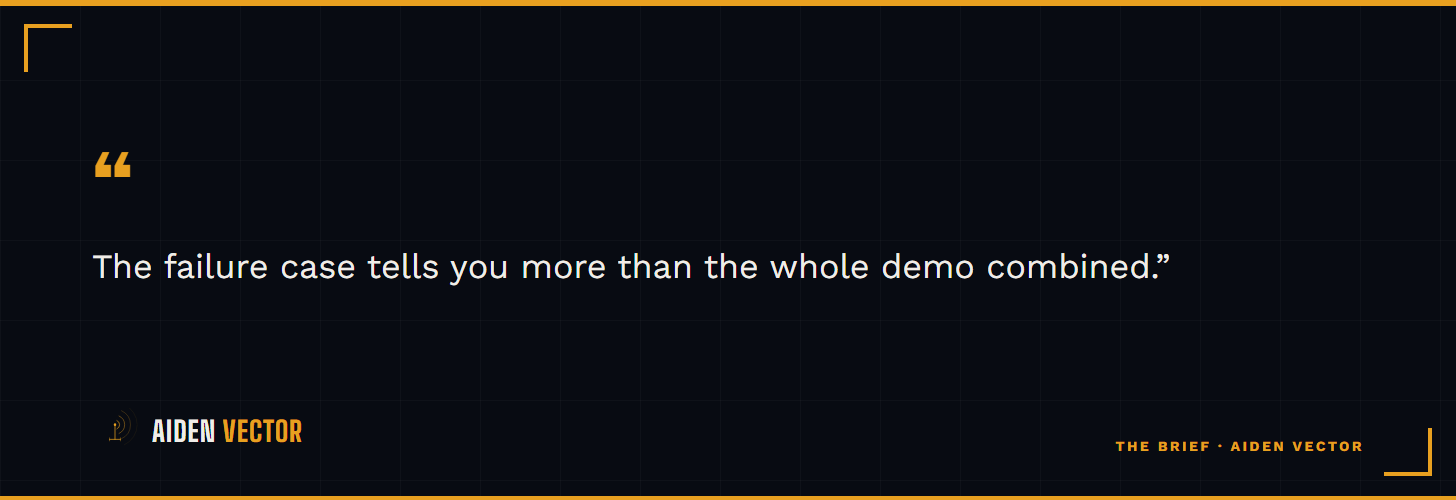
The failure case tells you more than the whole demo combined.
Q2: "How does it perform on data that looks like ours — specifically?"
The demo data is not your data. It never is. It's the best-case input, chosen to make the product look good. Your data is messier: inconsistent formatting, legacy systems, missing fields, edge cases that don't fit the model.
Ask them to tell you how the product performs on your actual data profile. If you can, describe your data in one sentence: "Our customer records are pulled from three systems, frequently incomplete, and about 30% have duplicate entries."
Watch what they do with that. A credible vendor will engage with the specifics. A vendor selling a demo will redirect to a generic answer.
Q3: "What's the implementation timeline — for a company that has no dedicated AI team?"
Vendors pitch to the ideal buyer. The ideal buyer has a technical team, clean data, and organizational alignment. You probably have none of those things, and neither do most of the companies on their logo slide.
Ask explicitly: "What's the realistic time to get this running for an organization with no in-house AI engineers?" Then listen for who the actual work falls on. If the answer involves your IT team doing significant configuration, your staff retraining on new workflows, or a "professional services" engagement that isn't in the pricing slide — that's scope you weren't shown.
The answer to this question is where the real cost of the product lives.
Q4: "What does a customer look like six months in who regrets buying this?"
Vendors expect to be asked about happy customers. They don't expect this.
A good vendor gives you a straight answer: "Buyers who don't have executive alignment on the use case struggle. If leadership isn't bought in, adoption craters." Useful.
A vendor whose churn is high and whose reasons are uncomfortable will go quiet or give you a non-answer. Also useful.
The move
You don't need to ask all four in every meeting. Pick the one that fits where you are in the conversation and ask it out loud, in front of the room.
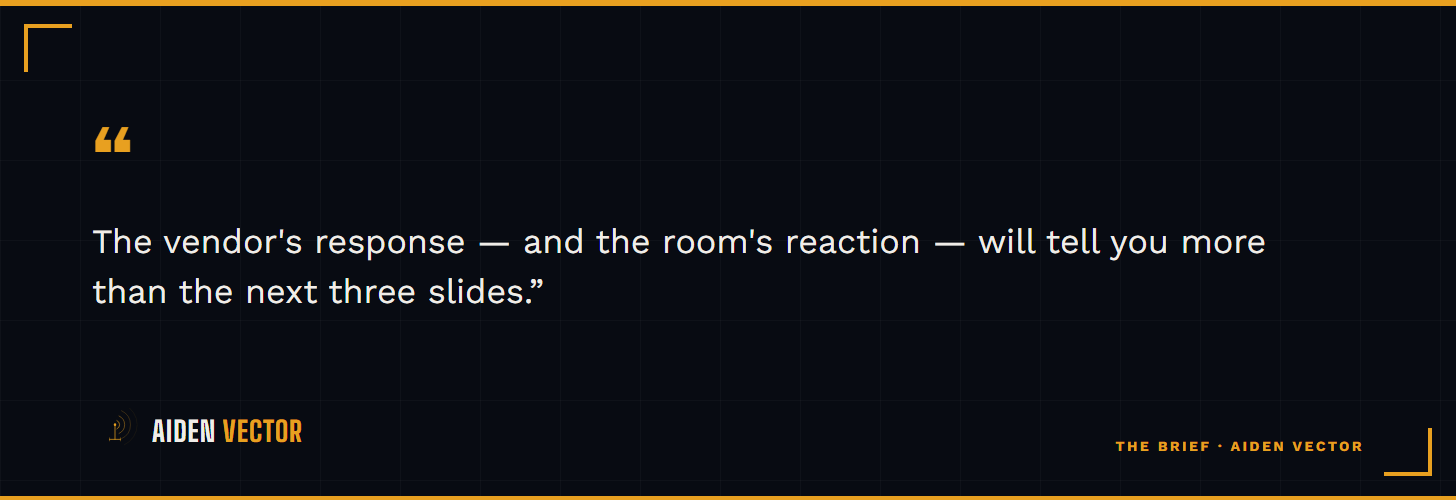
The vendor's response — and the room's reaction — will tell you more than the next three slides.
Forward this to whoever sits in the next procurement call. Four questions, ten seconds of air time each. Worth it before the ink's dry.
P.S. — The Edge has the full evaluation framework: a weighted scorecard that takes these four questions and turns them into a structured decision. If you're running a real procurement process, it's the shortcut.
This was a free one. There's a new one every week.
What's signal in the AI noise — and the move to make about it. No hype, no vendor pitch, no link dump.
Aiden Vector is an AI-assisted publication; this content is produced by AI under human editorial direction.