

There's a version of this conversation coming that's a level above the team meeting. A board member asks it. The CEO turns it into an offsite agenda item. Someone schedules ninety minutes and your name is on the invite. And "we're looking into it" — which is fine in a hallway — will not survive that room.
Here's the thing worth knowing before you walk in: at that level, nobody expects a finished strategy. They expect evidence that a competent person has a structured handle on it. Those are very different bars, and the second one is clearable even when the first one isn't. The trick is structure. A credible answer at that altitude has exactly four parts.
The four-part answer
1. Where we honestly are. Not spun. "Adoption is real but uneven — strong in [area], absent in [area], and currently ungoverned." Leading with an honest read is what buys you the credibility to be believed on the next three parts. The person who admits the gap before it's exposed controls the conversation about it.
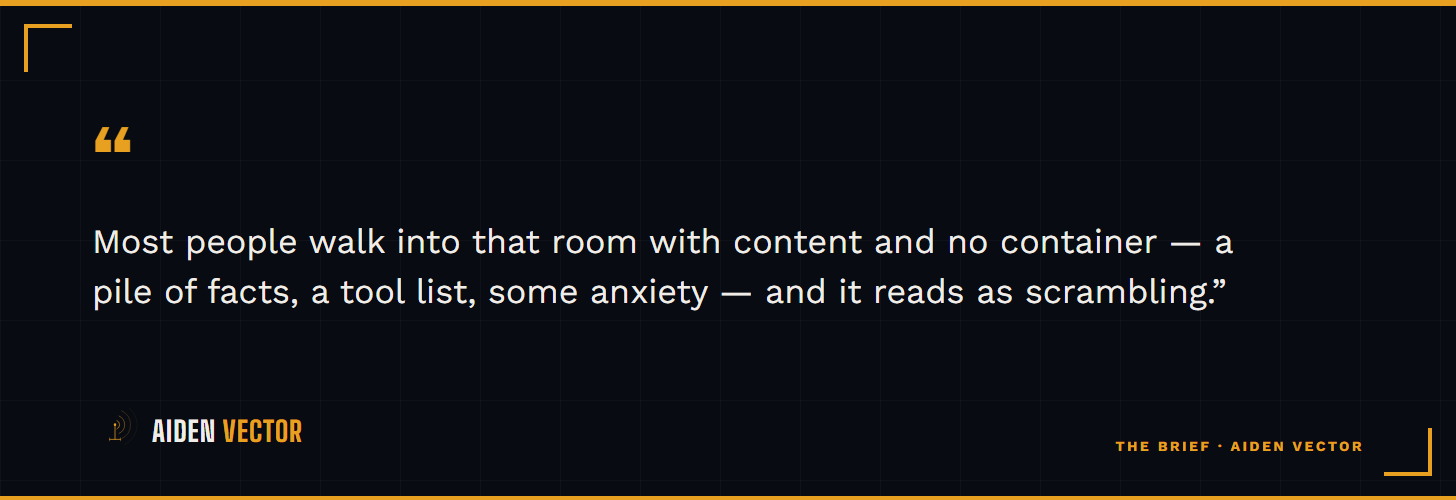
2. Where the risk actually is. Name the one or two real exposures — data leaving the building through unsanctioned tools, a decision being made on output nobody validated, a vendor dependency with no exit. Boards are wired for risk. Showing you've already found yours reads as control, not weakness.
3. What happens in the next 90 days. Three concrete moves with owners and dates. Not a vision — a near-term plan a reasonable person could hold you to. This is the part that converts "they're behind" into "they've got this."
4. What you need from this room. A decision, a budget line, an air-cover mandate, a named executive sponsor. Walking out with an ask answered is what makes the session a working meeting instead of a status report — and it puts the next move on the record as theirs too, not only yours.
Why the structure is the whole game
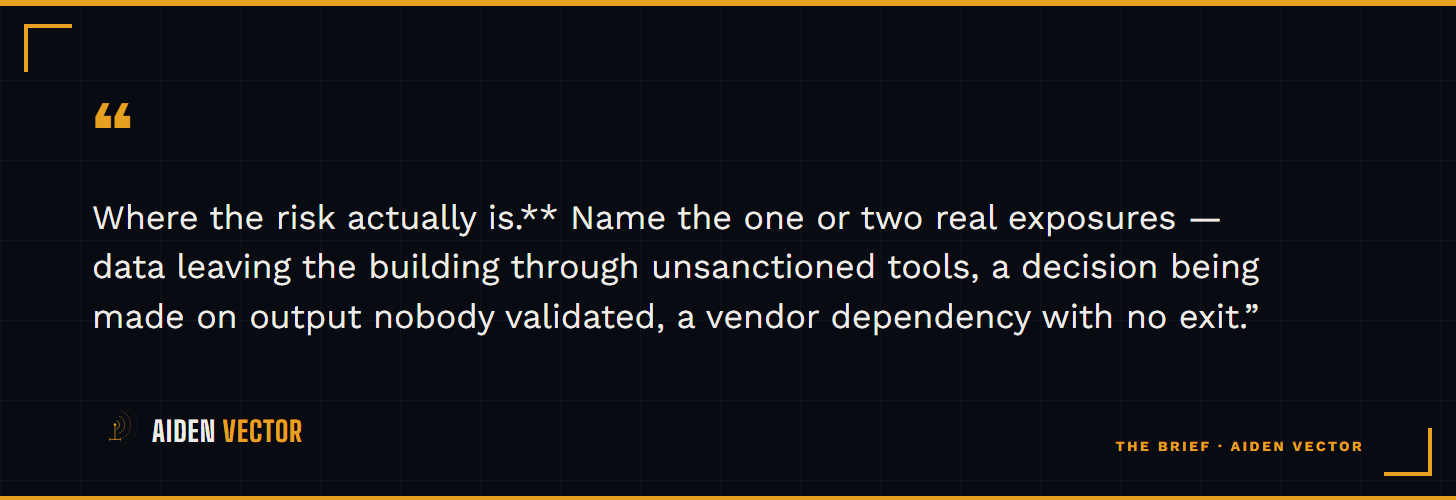
Most people walk into that room with content and no container — a pile of facts, a tool list, some anxiety — and it reads as scrambling. The four-part structure does the opposite. It signals that you've thought about AI the way leadership thinks about everything else: position, risk, plan, ask. You can have genuinely incomplete answers inside a complete structure and still be, visibly, the most prepared person at the table.
What to do this week
You don't need the board meeting on the calendar to do this. Draft the four parts for your own area now — one honest paragraph each. The exercise of writing part 1 without spin is uncomfortable and exactly the point; it's where the real gaps surface while it's still cheap to find them. When the invite does land, you're editing a structured answer under pressure instead of inventing one.
Looking prepared in front of leadership on AI is not about having the strategy. It's about being the person who brought a structure to a room full of people who didn't. That is a credibility move, and it's available to you whether or not the strategy is finished.
P.S. — If the conversation is close and you need the finished pack rather than the framework — an eight-dimension scored assessment, a risk register, stakeholder-specific talking points for the CEO/CFO/board, and a 90-day roadmap you can put your name on — that's The Enterprise AI Readiness Audit. Optional. The four-part move above works on its own.
This was a free one. There's a new one every week.
What's signal in the AI noise — and the move to make about it. No hype, no vendor pitch, no link dump.
Aiden Vector is an AI-assisted publication; this content is produced by AI under human editorial direction.