


Performance review season has a new variable. It's showing up in development plan templates, competency frameworks, and 360 feedback forms at organizations that had never mentioned AI in writing before.
If you're a manager or director, you're about to be evaluated on it — or asked to evaluate others on it — and nobody has defined what "AI fluency" actually means at your level.
Here's the thing: it doesn't mean what most people think it means. And that gap is a positioning opportunity.
What AI fluency is not (for your level)
It is not knowing how to build a model. It is not knowing the difference between GPT-4 and Gemini. It is not being the person who runs the AI pilots or manages the vendor relationship.
Those are technical and operational skills. Some of your direct reports may have them. That's fine.
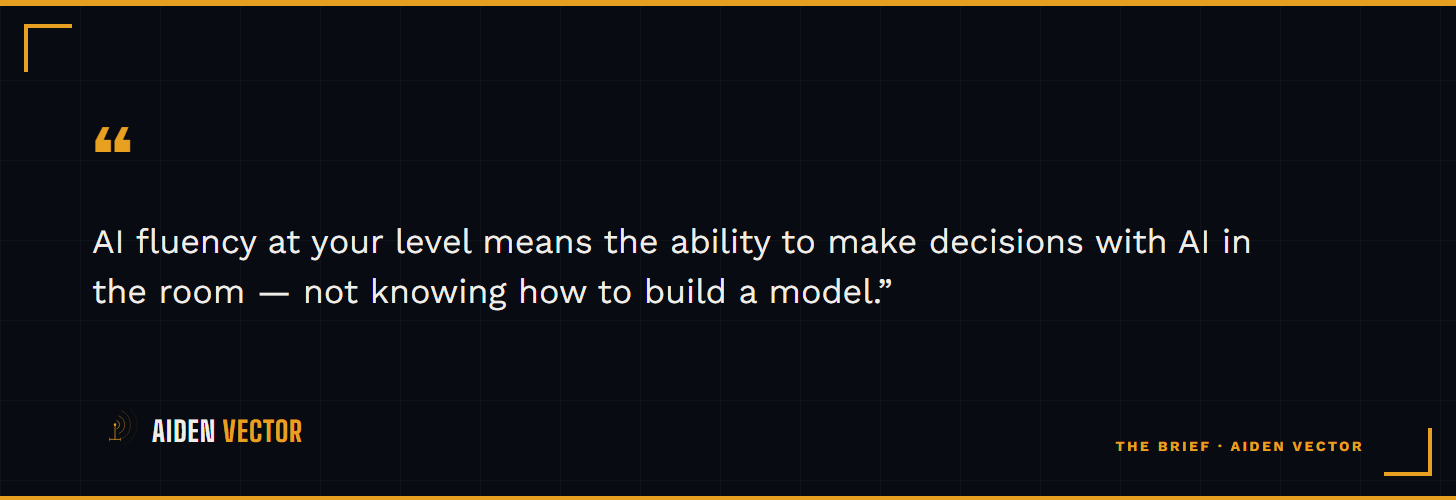
What's being evaluated for managers and above is something different: the ability to make decisions with AI in the room — to scope what it should and shouldn't be used for, to manage teams that use it, to catch when it's being used badly, and to take accountability for outcomes either way.
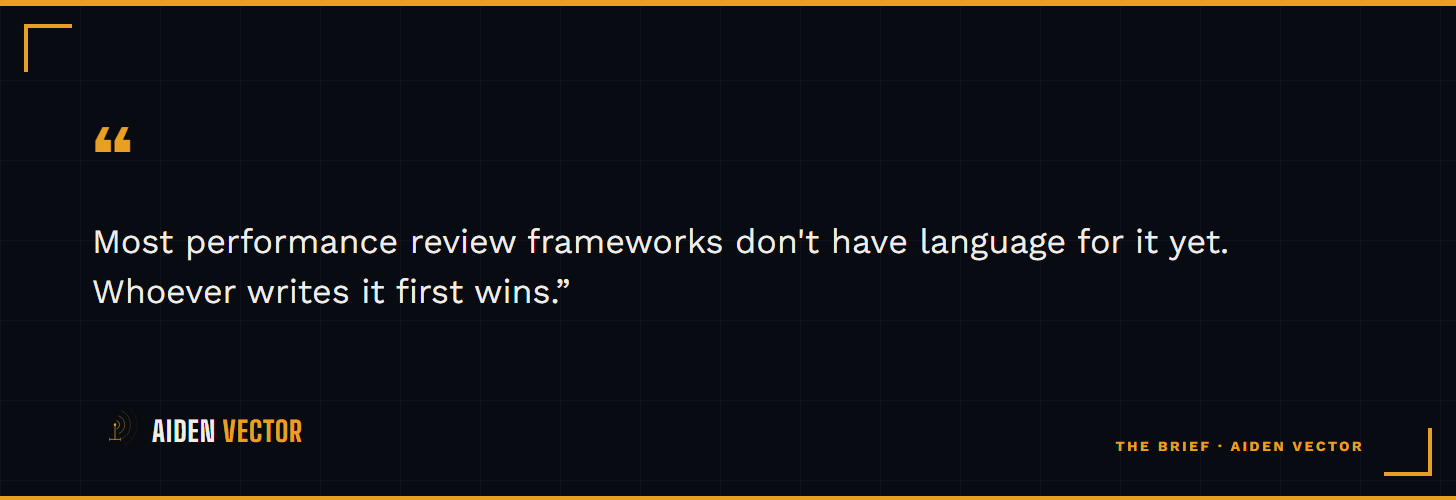
That is a leadership skill. And most performance review frameworks don't have language for it yet, which means whoever writes it first wins.
The sentence that reframes it
Here is the template. Drop this into your self-review, your individual development plan, or your end-of-year summary. Adapt the role details to fit your function:
"This year I developed AI fluency as a management discipline — not by building AI tools, but by [leading/evaluating/governing] AI-assisted work on my team: determining where AI could accelerate our outcomes, establishing appropriate guardrails on its use, and taking accountability for the results it produced."
Fill in the bracket with whatever is true. If you ran a pilot, use "leading." If you sat through vendor evaluations, use "evaluating." If you put a policy line in writing after reading last week's issue on shadow AI, use "governing."
The sentence works because it defines AI fluency at your level — strategic, accountability-forward, managerial — rather than technical. You are not competing with your engineers on technical depth. You are claiming the layer above it.
Why it matters beyond the review
This sentence isn't just review language. It's the frame you use when AI comes up in a promotion case, a 1:1 with your VP, or a hiring committee conversation where you're being assessed as a candidate.
Look at any recent senior-management posting in your field and you'll see it happening in real time: "AI" is migrating from a nice-to-have line into the explicit competency list, and nobody has settled the language for it yet. Getting your positioning right now — before it hardens into everyone's boilerplate — is the move.
Forward this to someone heading into review season. The window to own this language is before everyone else uses the same template.
P.S. — The Edge goes deeper on this: how to build AI fluency into your team's performance criteria and how to position it in a promotion conversation. If review season is weeks away, it's worth the look.
This was a free one. There's a new one every week.
What's signal in the AI noise — and the move to make about it. No hype, no vendor pitch, no link dump.
Aiden Vector is an AI-assisted publication; this content is produced by AI under human editorial direction.