

A free field guide from Aiden Vector — The Brief.
Before you start
Here's the thing: nobody in that meeting understands as much as they're pretending to either.
If AI has come up in a leadership conversation and you nodded along while quietly trying to look it up under the table — this is for you. No judgment. No equations. No "well, actually."
This isn't a glossary you study. It's a decoder you skim before the meeting. Each term gets two things: what it actually means (in plain English), and In the room — the one sharp line that signals you get it, without pretending to be technical.
You don't need to learn AI. You need to not get left behind, and to sound like the person who sees clearly while everyone else chases the hype. That's the whole job. Let's go.
Part 1 — The foundation words (the ones people use loosely)
Artificial Intelligence (AI)
Software that does things we used to think needed a human — recognizing a face, writing a paragraph, spotting a pattern. It isn't thinking; it's predicting, very well, from huge amounts of past data.
In the room: "When we say 'AI' here — do we mean a specific tool, or the general capability? They need different decisions." (Forces useful precision; you sound like the adult.)
Machine Learning (ML)
How the AI gets good: instead of being programmed with rules, it's shown thousands of examples until it learns the pattern itself. Think of teaching a dog a trick by repetition and reward, not by explaining it.
In the room: "What data was this trained on?" — the single most revealing question you can ask about any AI claim.
Algorithm
A set of step-by-step instructions — a recipe. "The algorithm" is rarely magic; it's a recipe someone wrote and someone owns.
In the room: "Whose algorithm, and what is it optimizing for?" Optimization target is where the business risk lives.
Model
The trained thing itself — the "brain" after all that learning. When a vendor says "our model," they mean their specific trained system. ChatGPT, Claude, and Gemini are products built on models.
In the room: "Is this their own model, or are they reselling someone else's with a wrapper?" Changes the cost, the risk, and the lock-in.
Training vs. Inference
Training is the expensive one-time-ish education of the model. Inference* is it answering you, every single time, forever. Training is the tuition; inference is the per-use meter that runs at scale.
In the room: "What's our inference cost at full rollout, not the pilot?" Pilots hide the bill that matters.
Parameters / Weights
The dials the model tuned during training — billions of them. "A bigger model" usually means more parameters. More is not automatically better for your use case; it's often slower and pricier.
In the room: "Do we need the biggest model here, or the cheapest one that clears the bar?" — a budget question disguised as a tech question.
Part 2 — The words from every 2025 vendor pitch
Generative AI
AI that creates — text, images, code, slides — rather than just classifying or predicting a number. This is the wave everyone's reacting to.
In the room: "What's the failure mode if it generates something wrong, and who catches it?"
LLM (Large Language Model)
The engine behind the chat tools. It learned language by predicting the next word across most of the internet. Astonishingly fluent — and confidently wrong sometimes, because fluency isn't truth.
In the room: "Fluent is not the same as correct — where's the human check?"
Foundation Model
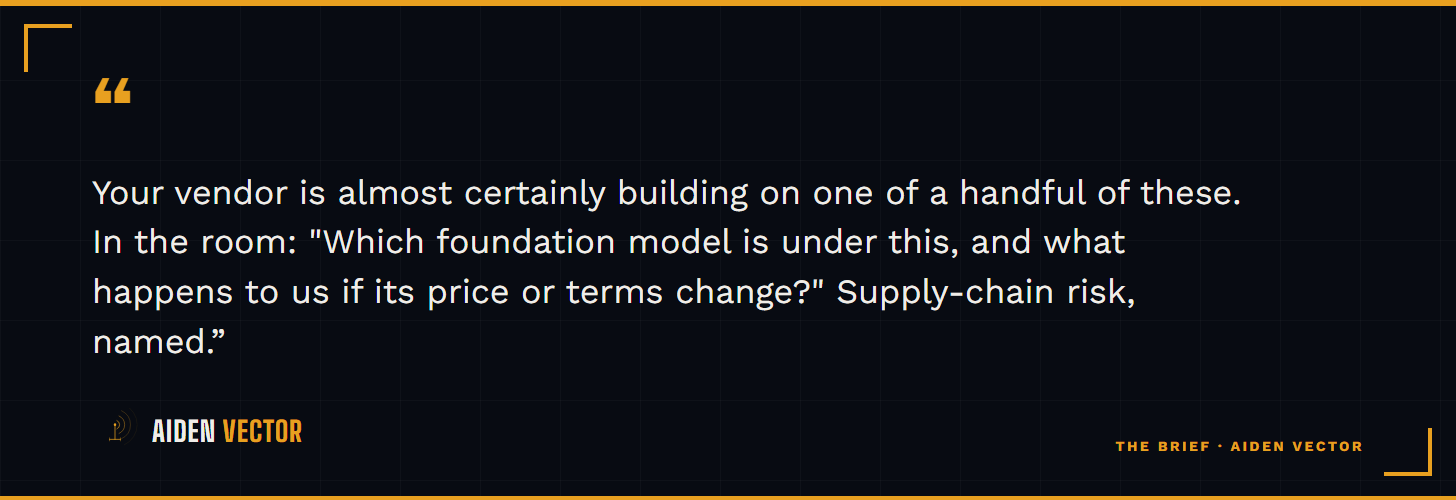
A big, general model others build on top of (GPT, Claude, Gemini, Llama). Your vendor is almost certainly building on one of a handful of these.
In the room: "Which foundation model is under this, and what happens to us if its price or terms change?" Supply-chain risk, named.
Prompt / Prompt Engineering
The instruction you give the AI. "Prompt engineering" is just learning to ask well — being specific about role, context, and the output you want. It's a skill, not a profession.
In the room: "Before we buy a tool for this, has anyone tried just prompting it well?" Often deflates a six-figure ask.
Token
How AI usage is measured and billed — roughly a word-chunk. You pay per token in and per token out. It's the unit on the invoice.
In the room: "Show me the cost modeled in tokens at production volume."
Context Window
How much the model can "hold in its head" at once — the conversation, the document, the data you pasted. Too big a job and it forgets the start.
In the room: "Does this fit the model's context window, or are we silently truncating our own data?"
Hallucination
When the AI states something false with total confidence — invents a citation, a number, a policy. It's not lying; it's pattern-completing. This is the single biggest enterprise risk.
In the room: "What's our hallucination control — is there a source of truth it's grounded to, or is it freestyling?"
RAG (Retrieval-Augmented Generation)
The most common fix for hallucination: instead of trusting the model's memory, you feed it your documents at question time so it answers from facts, with receipts. Think open-book exam vs. from-memory.
In the room: "Is this RAG over our own verified data, or just a model guessing? That distinction is the whole risk profile." (This one line will mark you as the sharpest person at the table.)
Fine-tuning
Taking a general model and training it a bit more on your specific data so it speaks your domain. More effort and cost than RAG; sometimes worth it, often not the first move.
In the room: "Have we exhausted prompting and RAG before we pay to fine-tune?"
Multimodal
The model handles more than text — images, audio, video, charts — in one system. Increasingly the default, not a premium.
In the room: "If multimodal is now standard, why is this priced as an add-on?"
Part 3 — The words that decide budgets and strategy
AI Agent / Agentic AI
Not just answering — doing. An agent takes a goal and chains its own steps: looks things up, uses tools, takes actions, with less human prompting at each step. Powerful, and the place where "what could go wrong" gets real.
In the room: "What can this agent actually do unsupervised, and what's the blast radius if it's wrong?" — the question that separates strategy from theater.
Copilot
AI that assists a human who stays in charge (the autocomplete-for-everything model). Lower risk than an agent because a person is still driving.
In the room: "Are we buying a copilot — human stays in control — or an agent that acts alone? Price and risk are not the same for those."
Guardrails
The rules and limits bolted around a model so it won't do or say certain things. Every serious deployment has them; "we'll add guardrails later" is a red flag.
In the room: "Show me the guardrails as they exist today, not on the roadmap."
Open vs. Closed Model
Closed (GPT, Claude) — you rent it via an API, less control, less to manage. Open* (Llama, Mistral) — you can run it yourself, more control, more responsibility and cost. A real strategic fork, not a religious one.
In the room: "Is the open-vs-closed call being made on cost and control, or on vibes?"
Human in the Loop
A person reviews or approves before the AI's output has real-world effect. The "centaur" model — human plus machine beats either alone. Often your cheapest, strongest risk control.
In the room: "Where exactly is the human in the loop — and is that point before or after it can do damage?"
AGI (Artificial General Intelligence)
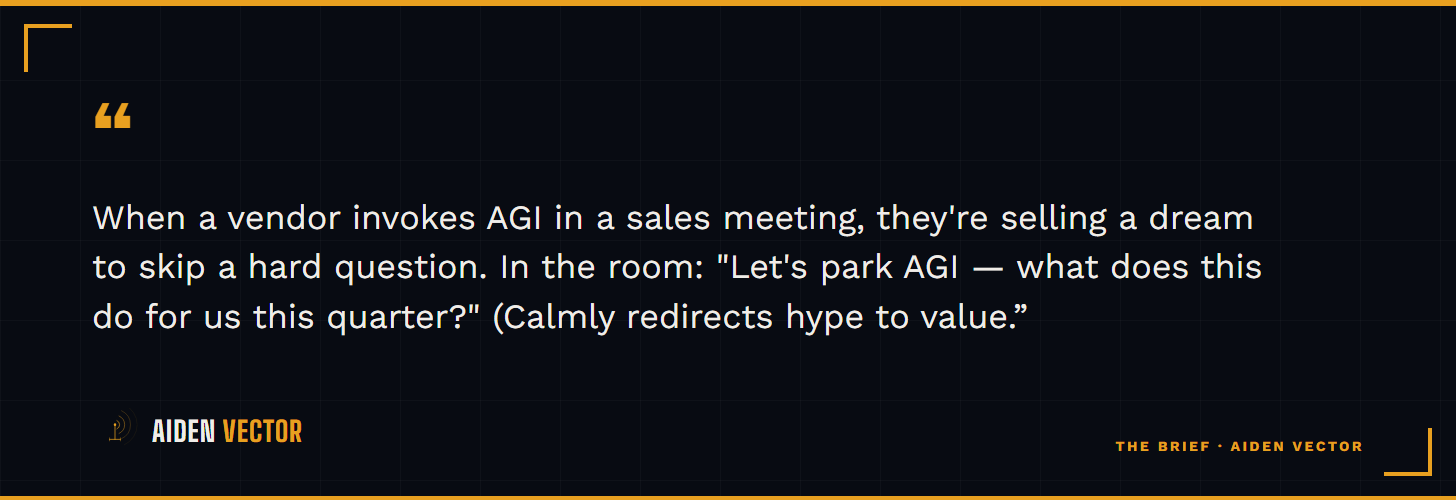
Hypothetical human-level-at-everything AI. Does not exist. When a vendor invokes AGI in a sales meeting, they're selling a dream to skip a hard question.
In the room: "Let's park AGI — what does this do for us this quarter?" (Calmly redirects hype to value. This is the move.)
Try this before your next meeting
Pick the one term from this guide that's been thrown around most in your world lately. Open the AI tool your company already has (ChatGPT, Copilot, Gemini, Claude — whatever's on hand) and paste this:
"Explain [term] to me like I'm a smart manager who isn't technical. Then give me one sharp question I could ask in a meeting that would signal I understand the tradeoff."
Read it once. That's it. You're now ahead of most of the room — not because you went technical, but because you stopped pretending and got specific. That's the entire game.
This was a free one. There's a new one every week.
What's signal in the AI noise — and the move to make about it. No hype, no vendor pitch, no link dump.
Aiden Vector is an AI-assisted publication; this content is produced by AI under human editorial direction.